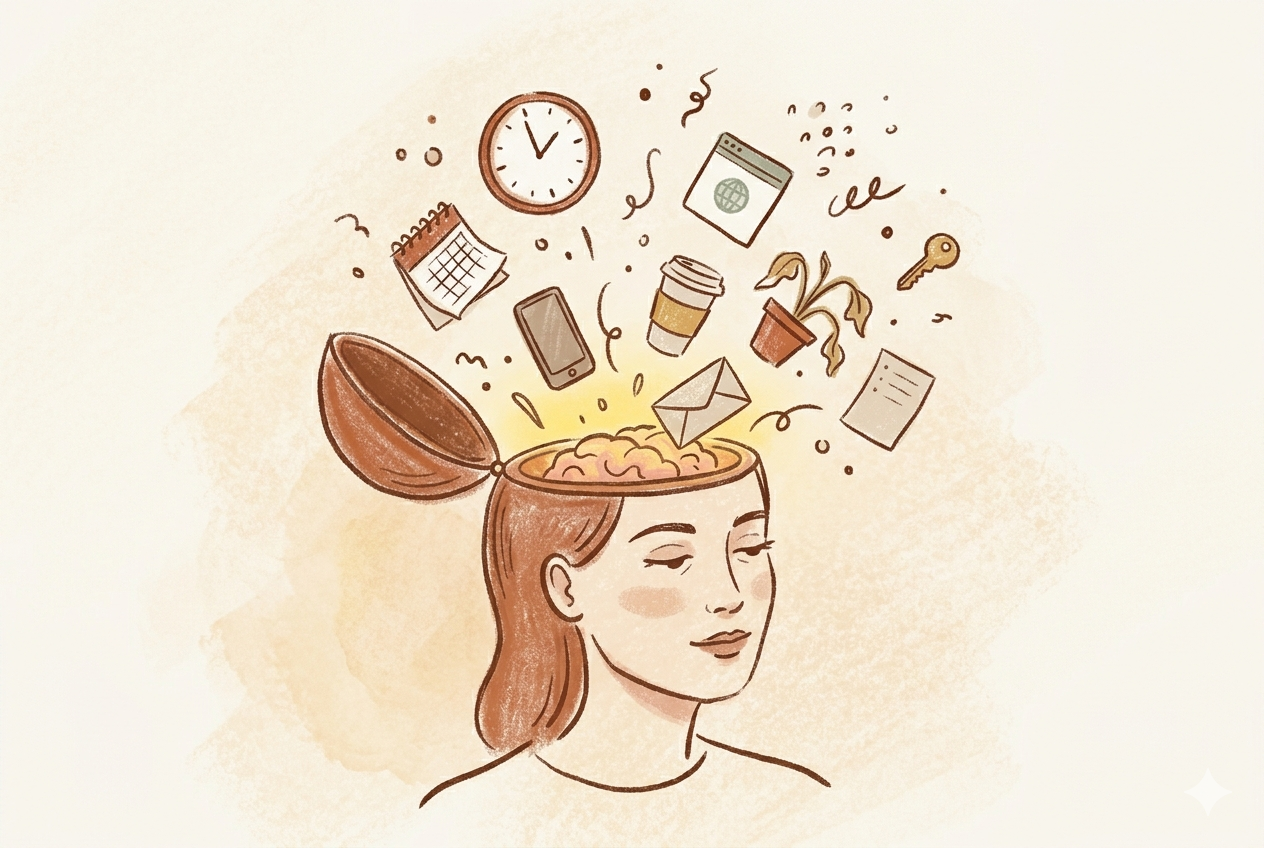
If you've ever felt a strange sense of relief after venting to a friend, crying in therapy, or just scribbling a chaotic to-do list on the back of an envelope — you weren't imagining it. Something genuinely shifted. The pressure dropped a little. The static got quieter.
Psychologists have been studying this phenomenon for about 40 years, and the conclusion is surprisingly consistent: getting things out of your head and into the world — whether by talking, writing, typing, or even just saying things out loud — has measurable, lasting effects on your mental and physical health. It's not a wellness platitude. It's neurologically real.
And for anyone quietly carrying an enormous invisible load — every appointment, every deadline, every thing that needs doing that exists nowhere but the back of their mind — this research is worth sitting with.
The experiment that started everything
In 1983, a psychologist named James Pennebaker ran what seemed like a strange study. He divided students into two groups. One group wrote about trivial topics — their shoes, the room they were sitting in, nothing that mattered. The other group wrote about the most traumatic experience of their lives, for 15 minutes a day, four days in a row.
Then he tracked how often each group visited the student health centre over the next six months.
The trauma writers went to the doctor at roughly half the rate of the control group. Half. From writing for an hour total. The finding was so unexpected it took years of replication before the broader research community fully accepted it. But replicate it did — across hundreds of studies, in dozens of labs, with healthy participants and clinical populations alike.
The trauma writers went to the doctor at roughly half the rate of the control group. Half. From writing for an hour total.
What Pennebaker had stumbled onto wasn't just a therapy trick. It was something more fundamental about how the mind handles unprocessed experience. When we don't externalise the things that are weighing on us — when we hold them in, suppress them, or just perpetually defer them — our brains have to keep actively working to do so. That suppression costs energy. Releasing it, in almost any form, returns that energy to us.
The working memory connection
Here's where it gets practically useful for anyone managing a mental load the size of a small country.
Researchers studying Pennebaker's work found something beyond the emotional benefits: expressive writing also improved working memory. Students who wrote about difficult experiences showed measurable increases in working memory capacity — their brains were literally better at holding and processing new information afterward.
The mechanism makes sense once you understand what working memory actually does. Think of it less like storage and more like a desk surface. The stuff that's sitting on top of it — the open loops, the unfinished thoughts, the things you're trying not to forget — takes up space. Every unresolved item is occupying a corner of that desk. When the desk is full, there's nowhere to put anything new.
Writing things down clears the desk. Not metaphorically — the research is specific about this. A 2020 study found that writing about upcoming tasks reduced intrusive thought patterns and freed measurable cognitive capacity for other activities. Your brain stops holding on to things it knows have been captured somewhere safe. It lets go.
This is why people who journal consistently report not just feeling better but thinking more clearly. The two things are connected. Emotional noise and cognitive clutter come from the same source.
What therapy is actually doing
It's worth stepping back for a second and asking what talking to a therapist actually does, neurologically.
A lot of it, it turns out, is exactly this: structured externalisation. You take something that exists as a diffuse, unorganised weight inside you — a fear, a resentment, a recurring anxiety — and you put it into words. You give it a shape. And in the process of giving it a shape, something shifts. Research shows that expressive writing activates the prefrontal cortex while dampening activity in the amygdala — the brain's threat-detection centre. You're not just processing the feeling. You're literally changing which part of your brain is running the show.
You take something that exists as a diffuse, unorganised weight inside you and you put it into words. You give it a shape. And in the process of giving it a shape, something shifts.
One 2006 study found that journaling could be as effective as cognitive behavioural therapy in reducing depression risk in young adults. That's not an argument against therapy — therapy involves a skilled human who can respond, push back, and hold space in ways that writing alone can't. But it does tell us something important: the act of externalisation is doing more of the therapeutic work than we typically credit it for.
But here's what actually matters when you're juggling everything
Most of the research above focuses on emotional processing — writing about trauma, working through difficult feelings, making sense of hard experiences. That's genuinely valuable. But there's another dimension of the mental load that's less emotional and more logistical: the sheer number of tasks, deadlines, responsibilities, and things-that-need-doing that busy people carry around in their heads at any given moment.
And the same principle applies here. Maybe even more so.
When a task exists only in your mind, your brain treats it as unfinished business. It keeps surfacing it — at 2am, mid-conversation, in the shower — because that's what brains do with open loops. Psychologists call this the Zeigarnik effect: we have a stronger cognitive pull toward incomplete tasks than completed ones. The dentist appointment you haven't made yet will interrupt your thinking far more than the one you've already scheduled.
This is why the act of capturing a task — actually getting it out of your head and into something external — provides immediate relief that goes beyond just "not forgetting it." Your brain registers the capture as closure. The open loop closes. The cognitive resources being spent holding that task are freed up for something else.
The catch is that the system has to be one you actually trust. If you write something down but don't believe it'll surface at the right moment, your brain won't let it go. It'll keep holding on just in case. The reliability of the external system is the whole point.
Voice is a different kind of release
Something worth noting: the research on externalisation isn't limited to writing. Speaking thoughts aloud — to a therapist, into a voice memo, even to yourself in the car — produces similar effects. There's something about the act of giving form to something formless that matters, regardless of the medium.
In therapy, this is sometimes called "naming to tame" — the idea that labelling an experience activates different neural pathways than simply experiencing it. A fear named is a fear you can work with. A to-do list spoken aloud is a to-do list your brain can release.
A fear named is a fear you can work with. A to-do list spoken aloud is a to-do list your brain can release.
For people already stretched thin, voice feels like the lowest-friction option. You're narrating constantly anyway — to colleagues, to yourself on a commute, under your breath in the middle of a busy day. The barrier to speaking is lower than the barrier to sitting down and writing. Which matters, because the biggest obstacle to externalising your mental load isn't knowing it's a good idea. It's having a fast enough way to do it that you'll actually use it.
The practical upshot
If there's one thing the research is consistent about, it's this: the method matters less than the act. You don't need a beautiful journal and a dedicated ritual. You don't need to process your deepest feelings or find exactly the right words. You just need to get things out of your head and into something that exists outside it.
A voice note. A scribbled list. A quick typed brain dump on your phone. Pennebaker's participants wrote for 15 minutes. Studies on task capture show benefits from writing a single sentence. The friction is the enemy — not the format.
Your mental load is real. The cognitive cost of carrying it is documented and significant. And the relief that comes from putting it somewhere — really putting it somewhere, in a system you trust — isn't just a feeling. It's your brain doing exactly what 40 years of research says it's designed to do when you finally let it.
You were never meant to hold all of this alone.