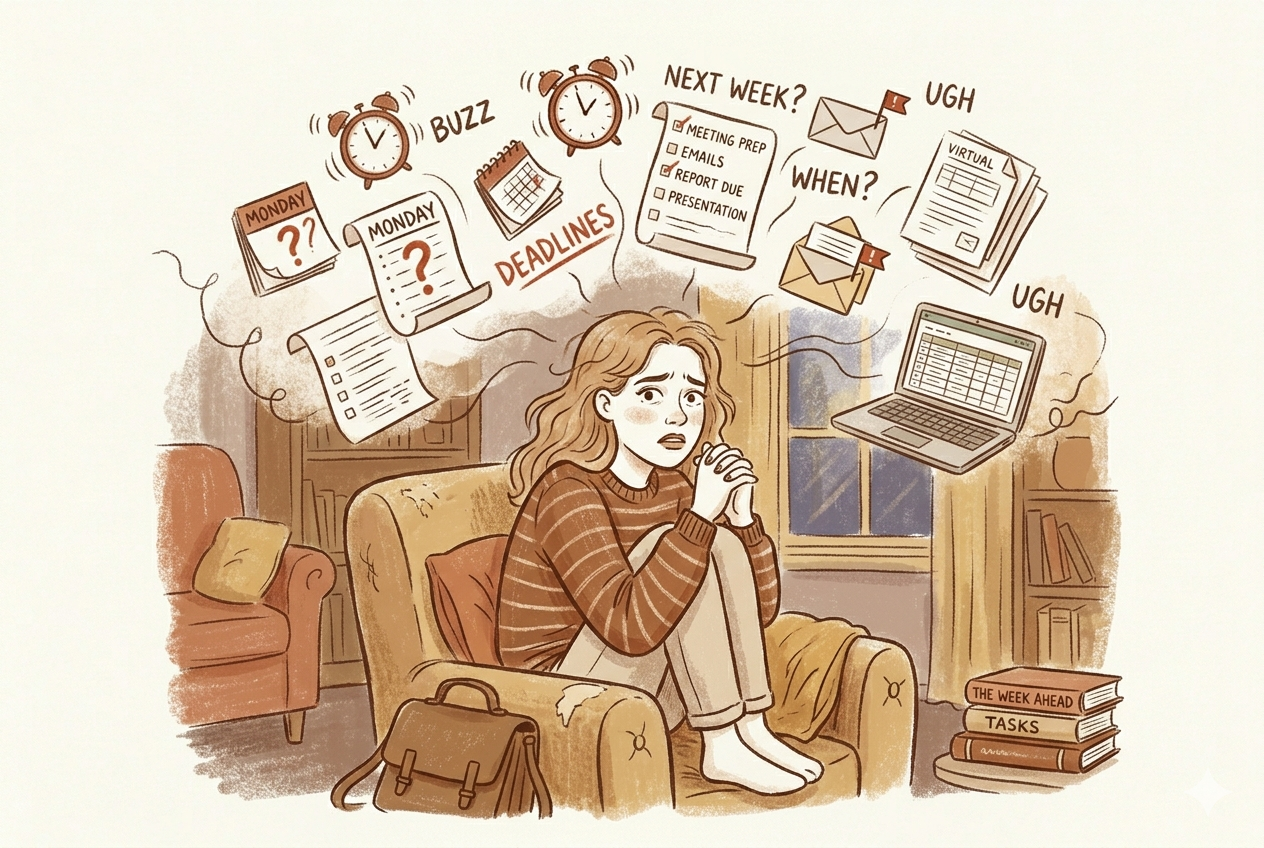
It arrives at roughly the same time every week. Sunday afternoon, somewhere between the end of lunch and the beginning of evening. The weekend isn't over yet — technically you still have hours — but something has shifted. A low hum of dread has started up somewhere in the background. The week ahead is assembling itself in your mind, uninvited and slightly ominous, and no amount of television or fresh air quite drowns it out.
You know this feeling. Most people do. It even has a name now — the Sunday scaries, or the Sunday blues — which is both reassuring (you're not alone) and slightly alarming (it's so universal it has its own Wikipedia page).
What's less well known is what's actually happening when the dread sets in. It's not weakness. It's not ingratitude. It's not a sign you're in the wrong job, though sometimes it is a sign of that too. It's a neurological event — a predictable, documented response to a specific set of modern pressures — and understanding it is the first step to doing anything useful about it.
The numbers are bigger than you'd think
The Sunday scaries are not a niche experience. A LinkedIn-commissioned survey found that 80% of American professionals experience them. A separate survey by the American Academy of Sleep Medicine found that 79.5% of US adults report trouble falling asleep on Sunday nights compared to other days of the week. Sunday is, by multiple measures, the unhappiest day of the week — with Saturday as the peak and the gap between them one of the steepest emotional drops in the seven-day cycle.
There's even a specific timestamp. Research tracking when Sunday anxiety tends to arrive puts it at approximately 3:54pm — a finding that is both absurdly precise and completely believable to anyone who has felt the afternoon light change and known, viscerally, that something was about to get harder.
For younger people the picture is starker. 74% of Gen Z respondents experience Sunday scaries at least once a month — a higher rate than any other age group. For 10% of them, the anxiety starts as early as 6am on Sunday. The weekend barely gets going before it's already shadowed by what comes next.
What's actually happening in your body
The Sunday scaries are a form of anticipatory anxiety — which sounds clinical but is actually just a very human thing your nervous system does when it senses something stressful is coming.
Anticipatory anxiety triggers a genuine fight-or-flight response. Cortisol and stress hormones rise. Your stomach tightens. Sleep suffers. The dread isn't irrational — it's your nervous system responding to a predicted threat. The meeting that's 36 hours away feels urgent and threatening right now because, as far as your body is concerned, it might as well already be happening.
Research on cortisol and anticipatory stress makes this concrete in an uncomfortable way. The cortisol awakening response — a rapid rise in cortisol concentration shortly after waking — is hypothesised to prepare the organism to cope with upcoming demands. In plain terms: your body starts warming up for Monday before you've even gone to sleep on Sunday. You're paying a physiological cost for a day that hasn't arrived yet.
You're paying a physiological cost for a day that hasn't arrived yet. Your body starts warming up for Monday before you've even gone to sleep on Sunday.
There's a default mode network dimension to this too. Sunday evening marks the moment when weekend activities wind down and mental space opens up, giving unresolved work concerns room to resurface. When you're busy — doing things, being places, staying present — the unfinished business stays in the background. The moment you slow down, it floods the space. Sunday evening is essentially a perfect environment for your brain to surface everything it's been holding.
This is not just about hating Mondays
It's tempting to frame the Sunday scaries as a simple work problem — you dread your job, so you dread going back to it. Sometimes that's true. But the research is more interesting than that.
Sunday scaries are often less about job dissatisfaction and more about the mental load of transitioning from rest to work, combined with uncertainty, workplace dynamics, and the pressures of modern work culture. The top contributors, according to a 2024 survey of 2,144 workers, were workload and deadlines (33%), burnout and exhaustion (24%), and unrealistic expectations (16%). Notably, not "I hate what I do."
The autonomy dimension matters here. Your nervous system notices the sharp shift from weekend freedom to work constraints, creating a kind of psychological whiplash. On Saturday morning, your time belongs to you. By Sunday night, you're mentally preparing to hand over control of your schedule to meetings, deadlines, and other people's priorities. That loss of self-direction is, for a lot of people, the actual thing they're dreading — not the work itself.
The cultural dimension is worth sitting with too. The always-on workplace hasn't just colonised working hours — it has colonised the hours immediately before working hours. "The workplace culture in America does not always favour rest and time away from work, instead favouring checking emails while out of office and working long hours. Simply put, the burnout factor is higher, and the youngest generations are seeing it and struggling more to cope." The Sunday scaries, in this frame, aren't a personal failure. They're a symptom of a system that never fully lets you leave.
Why the list in your head is always worse than the list on paper
Here's the part that's actually actionable — and it connects back to something we've written about before in these pages.
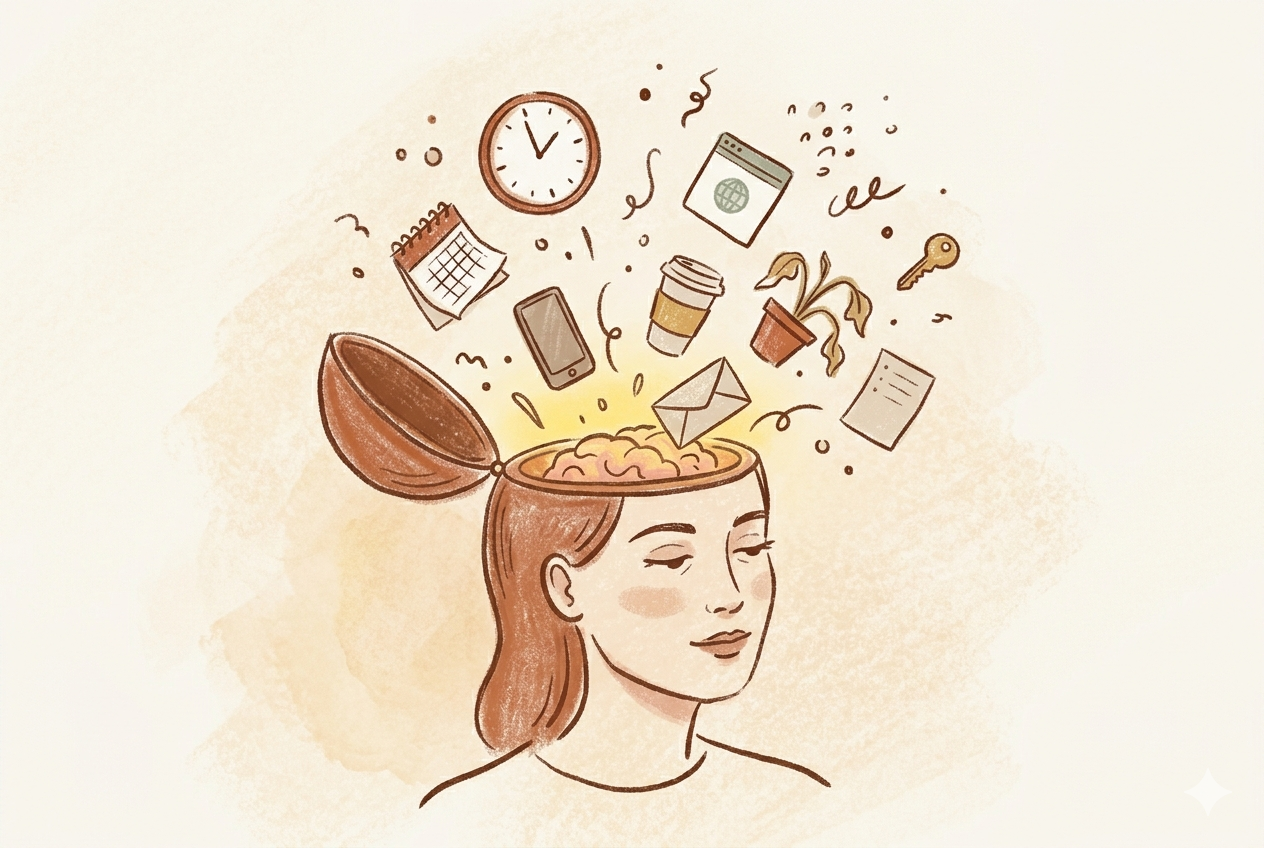
A significant driver of Sunday dread is the Zeigarnik effect: your brain's tendency to keep surfacing unfinished business, to hold open loops in working memory and return to them uninvited. The tasks you haven't started, the emails you haven't sent, the thing you said you'd do last week and didn't — these sit in your mind not as discrete items but as a diffuse, slightly shapeless mass of unresolved obligation. And diffuse, shapeless masses are neurologically harder to tolerate than concrete lists.
Research in the Journal of Experimental Psychology shows that simply writing down pending tasks — a "brain dump" — frees up working memory and lowers rumination, the process of running over and over things in your mind. This is the same mechanism we wrote about in our piece on externalising thoughts: your brain relaxes its grip on things it knows have been captured somewhere safe.
Diffuse, shapeless masses of obligation are neurologically harder to tolerate than concrete lists. Getting the week out of your head and onto something external is not a productivity hack. It's closer to first aid.
There's something specifically useful about doing this on Sunday evening, before the week begins rather than after it's already underway. Not as a productivity ritual — not colour-coding your calendar or blocking your time or optimising your morning routine. Just the simple act of emptying your head. Getting the week out of your mind and into something external, so your brain can stop rehearsing it.
Research on anticipatory stress regulation adds another layer: individuals with high expectancies of being able to deal with upcoming stressful situations activate regulatory mechanisms during anticipation that improve their stress response. In plain language: people who feel prepared experience the same Monday, with measurably less cortisol. The dread is partially a response to uncertainty. Reducing the uncertainty — even a little, even just knowing what's actually on your plate — shifts the nervous system's assessment of the threat.
The uncomfortable bigger picture
It would be easy to end here with a list of coping strategies. But the Sunday scaries are also telling us something structural that deserves a moment.
The findings point to a larger cultural shift, where stress spills into personal time and affects wellbeing long before the workweek begins. Nearly half of full-time workers believe a four-day workweek would ease Sunday anxiety. Pilot programs in countries like the UK and Iceland show that shorter workweeks can improve both productivity and mental health. The fact that a substantial portion of the working population spends Sunday in a physiological stress response suggests that something in the design of how we work needs rethinking — not just how individuals manage their Sunday evenings.
That's a longer conversation than one article can hold. But it's worth naming: your Sunday dread is not just yours. It's shared, it's documented, it's getting worse, and it's disproportionately affecting people who are earlier in their careers and have the least structural power to change the conditions creating it.
What you can do in the meantime — tonight, this Sunday, the one after that — is make the shapeless a little more concrete. Get what's in your head out of your head. Not to optimise your week. Just to stop your nervous system from having to hold it all alone until Monday arrives.
The dread, it turns out, is mostly about the unknown. And the unknown shrinks considerably the moment you write it down.
Which is why we built Carry around this idea
Carry is a mental load app built on a straightforward premise: the things living in your head, unresolved and unrecorded, cost you more than you realise. Not just on Sunday evenings — though Sunday evenings are a particularly vivid demonstration — but constantly, in the background, as a low-level drain on your attention and your calm.
The research that shaped how we built it is the same research in this article. The Zeigarnik effect. The cortisol cost of unresolved open loops. The evidence that a brain dump — getting things out of your head and into something external — genuinely lowers rumination and frees up cognitive space. We didn't build a to-do list. We built something designed to make that act of externalisation as fast and frictionless as possible, so the gap between "I need to remember this" and "it's captured and I can let it go" is as small as it can be.
If Sunday evenings feel heavier than they should, it might be worth asking how much of that weight is things your brain is holding that don't need to live there. Getting them out — really out, into something you trust — is not a productivity hack. It's closer to putting something down that you've been carrying for longer than you noticed.