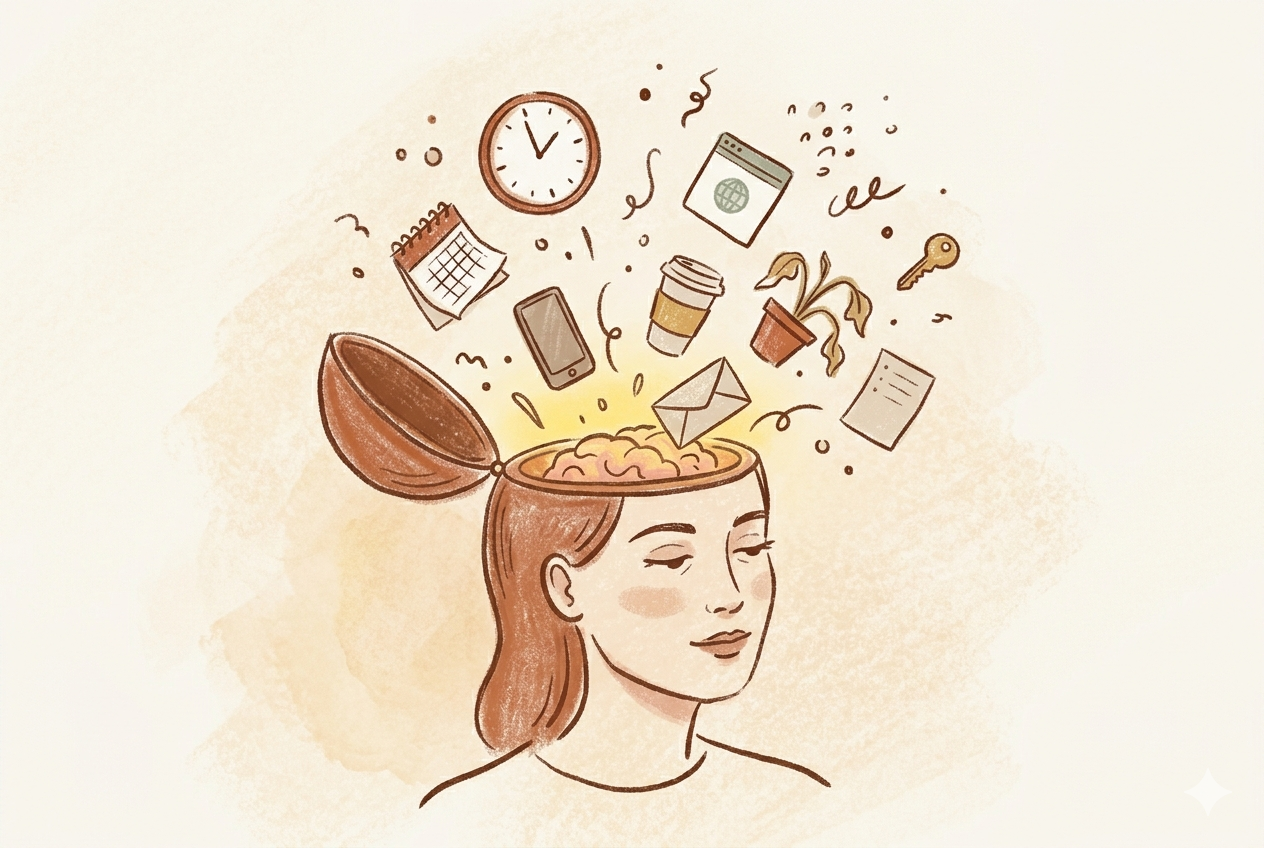
There is a specific kind of frustration that comes from knowing exactly what you need to do and being completely unable to start. Not unwilling. Not lazy. Genuinely, puzzlingly unable to initiate even when the task is small, even when you care about it, even when you have the time. You think about it. You think about thinking about it. And then something else takes over and the moment is gone.
There is also a related experience: holding a thought carefully in your mind, carrying it through a meeting or a conversation, telling yourself you will capture it in a moment, and then it simply is not there anymore. Not misplaced. Gone. As if it was never fully formed to begin with.
These experiences are more common than most people realise, and more documented. They sit at the intersection of working memory, executive function, and the particular cognitive profile that has become one of the most talked-about in the last decade: ADHD, which is now estimated to affect 15.5 million adults in the United States alone, with millions more likely undiagnosed.
This article is not about diagnosis. It is about a specific mechanism, why some brains struggle to hold things, and what the research says about why speaking out loud turns out to be one of the most effective ways to work with that, rather than against it.
First, the GPS that is not working
Dr. Russell Barkley, one of the most cited researchers in ADHD science and a clinical professor of psychiatry at Virginia Commonwealth University Medical Center, describes working memory as the brain's GPS. It is the system that holds your current position, tracks where you are going, and reroutes in real time as conditions change. Without it functioning well, you can know your destination and still find yourself going in circles, or standing still.
Working memory is not just about remembering things. It is about holding information in mind long enough to act on it. Following a sequence of steps. Keeping a goal in view while handling the immediate. Bridging the gap between intention and action. When this system is stretched or impaired, the effects are specific: tasks that seem simple become hard to start. Thoughts that arrive clearly do not stay long enough to be captured. The connection between "I need to do X" and actually doing X gets interrupted somewhere in between.
Working memory is the brain's GPS. Without it functioning well, you can know your destination and still find yourself going in circles, or standing still.
For people with ADHD, this is not a discipline issue or a motivation issue. Barkley's research has been consistent on this point for decades: ADHD is fundamentally a disorder of executive function, not attention in the simple sense. The brain is not unwilling. It is working with a system that does not hold things reliably. Telling someone with working memory difficulties to "just remember" is roughly equivalent to telling someone with a broken compass to navigate more carefully. The tool is the problem, not the effort applied to it.
Why women have been missing from this conversation
A brief detour that is relevant to a lot of readers: ADHD was historically studied almost exclusively in boys. The hyperactive, disruptive presentation, the child who cannot sit still, who acts out, who gets referred for assessment, was for decades the primary model. Girls, and later women, who presented differently were missed.
Women with ADHD are more likely to present with inattentive symptoms rather than hyperactive ones: difficulty sustaining focus, losing track of thoughts, forgetting things, struggling to begin tasks, feeling overwhelmed by things that seem to come easily to others. These symptoms are easier to overlook, easier to misattribute to anxiety or stress or simply being scattered, and considerably less likely to trigger a referral for assessment.
The result: decades of women developing elaborate coping strategies, working harder than necessary to compensate for a cognitive difference that was never identified or named. The percentage of adult women newly diagnosed with ADHD doubled between 2020 and 2022. Many of those women were in their 30s and 40s. Many described a specific experience of recognition: finally having a framework for something they had been managing, invisibly, for most of their adult lives.
This matters for the rest of this article because many of the strategies that help, externalisation, voice capture, reducing the cognitive overhead of task management, are strategies that work whether or not you have a diagnosis. They work because of how working memory functions, not because of any label attached to it.
The case for speaking out loud
Here is where the research gets practically interesting.
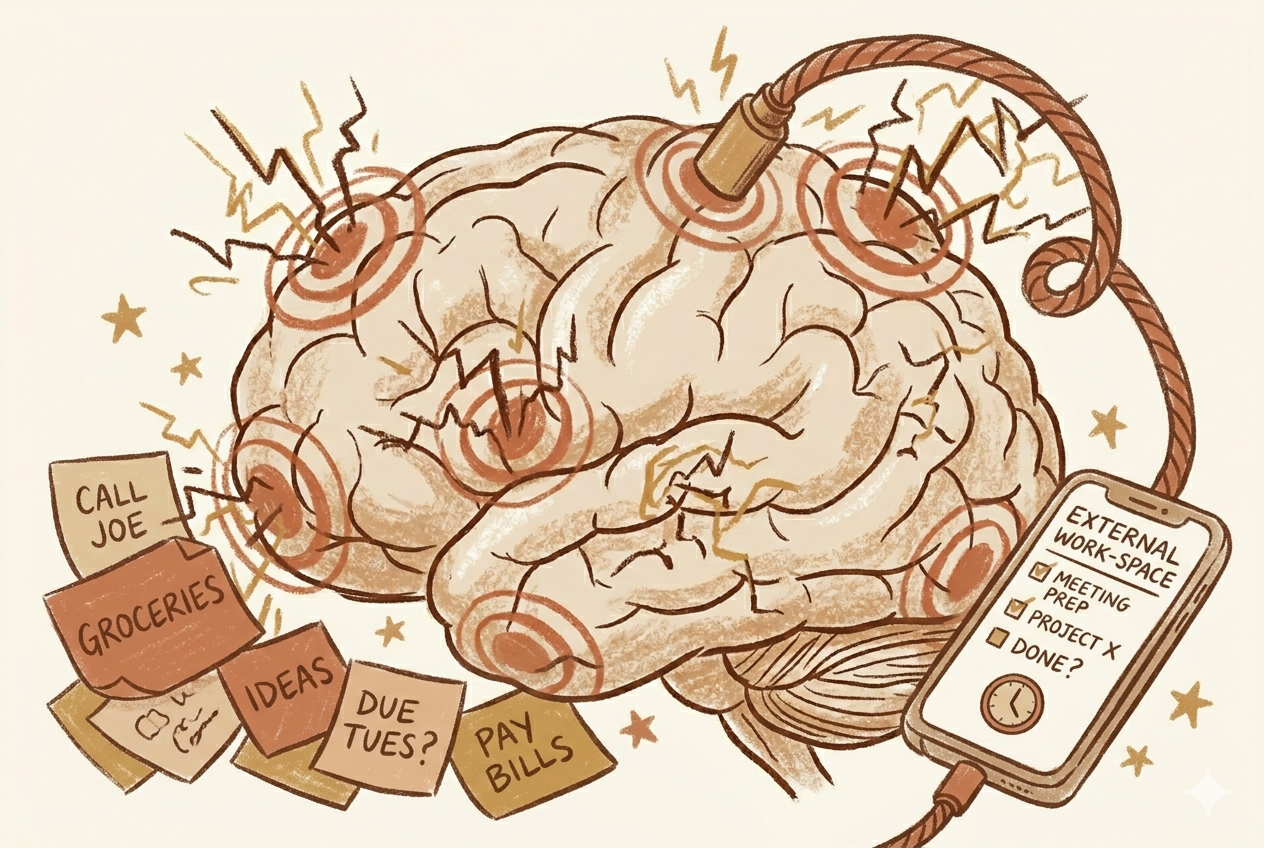
Barkley's work on ADHD and executive function includes a specific, evidence-based recommendation: externalise information. Get it out of your head and into the world in some physical form. Do not rely on internal memory to hold things. Use external systems instead. This is not a coping trick. It is a neurological strategy that works because it offloads the holding function from a stretched working memory onto an external system that does not forget.
His specific language is worth quoting: "You cannot rely on mental information to guide you, to help you remember. You need to be using journals and sticky notes and cards and reminders and all this other technology. You have to offload your working memory onto other devices."
You have to offload your working memory onto other devices. Out of sight is out of mind, which means getting things into sight is how you stay connected to them. — Dr. Russell Barkley
The phrase "out of sight is out of mind" appears in Barkley's work not as a metaphor but as a literal description of how working memory functions for many people. If something is not visible, present, or recently verbalised, it does not reliably exist as a prompt for action. Which is why capturing thoughts the moment they arrive, rather than trusting you will remember them later, is the key behaviour, not a nice-to-have.
Voice, specifically, has particular advantages here. Speaking activates different neural pathways than thinking silently. Research on self-talk and ADHD draws on a thread that goes back to the psychologist Lev Vygotsky, who theorised in the 1920s that externalised speech, thought spoken out loud, serves as a scaffold for self-guidance and self-direction. Where neurotypical brains gradually internalise this speech as private inner monologue, research suggests that for some brains, particularly those with ADHD-related executive function differences, keeping that speech external can provide the same scaffolding effect throughout life.
What happens when you say it out loud
The ADD Resource Center, drawing on Barkley's clinical framework, describes verbal externalisation as creating an "external storage system" for information that might otherwise slip away. When you speak your thoughts, you create a physical event in the world, sound waves that existed, that you heard yourself produce, rather than a purely internal representation that is vulnerable to being displaced by the next incoming thought.
Several things happen when you verbalise a task or thought rather than just thinking it.
The act of forming words forces specificity. You cannot mumble a vague intention into a voice memo and have it remain vague. Speaking out loud, "I need to call the school about Leo's registration before Thursday," forces the thought into a shape that is actionable rather than amorphous. Research on voice planning found that speaking a time block or intention makes its feasibility immediately apparent in a way that silent thinking does not. "From nine to twelve I will finish the entire project" sounds obviously unrealistic when you hear yourself say it. The voice creates a reality check that internal thought bypasses.
Verbalising also serves as what Barkley calls "point of performance" support, bringing the coping mechanism into the exact moment where it is needed, rather than relying on recall later. The thought arrives. You speak it. It is captured. You do not need to carry it.
The task initiation problem specifically
One of the least-discussed symptoms of ADHD, and one of the most debilitating in daily life, is task initiation difficulty. This is the gap between knowing you need to do something and actually beginning it. It is distinct from procrastination in the ordinary sense. It is not avoidance driven by anxiety about the task, or laziness, or poor time management. It is a specific failure of the executive function system to fire the starting signal.
Research from ADDitude Magazine found that externalising intentions through speech helps specifically with this barrier. Speaking activates the neural pathways involved in initiating action in a way that silent intention does not always manage. Saying "I am going to open my email now and reply to the three messages from this morning," out loud, to yourself, to a voice recorder, to anyone, functions as an activation mechanism. It bridges the gap between intention and action in a way that internal thought alone can fail to.
This is why body doubling works for so many people with ADHD: having another person present, even silently, provides an external anchor that helps initiate and maintain focus. Voice capture works through a related mechanism. You are not just recording the thought. You are activating something by speaking it.
The friction problem is not a small thing
All of this research points toward a practical conclusion: for brains that struggle to hold things, externalisation is not optional. It is the strategy. The gap between "I thought of something" and "that thing is captured" needs to be as small as possible, because the working memory system that would otherwise bridge that gap is the one that is not reliably doing its job.
This is where friction becomes clinically significant rather than just annoying. For most people, a slightly cumbersome capture system is inconvenient. For someone whose working memory does not hold things reliably, the three steps between thinking a thought and getting it safely captured are three opportunities for the thought to evaporate. A capture process that takes 30 seconds is one that will often be skipped. A capture process that takes two seconds, tap, speak, done, is one that might actually be used, reliably, at the moment it matters.
For brains that struggle to hold things, the gap between a thought arriving and that thought being captured needs to be as close to zero as possible. Friction is not just annoying. It is the thing that makes the system fail.
Cognitive-behavioural research on ADHD management is consistent about this: the strategies that work are the ones that are immediate, simple, and happen at the point of performance, at the moment the thought arrives, not later when you have found a pen or opened the right app or remembered you were meant to write something down.
Which is what Carry is designed around
Carry was built on the premise that the gap between a thought and a captured thought should be as small as possible. One tap. Speak. Done. The organising, the categorising, the surfacing back at the right moment, all of that happens after. The only thing that matters in the moment is getting the thought out of your head before it is gone.
The research in this article is the research that shaped those decisions. Barkley's externalisation framework. The evidence on voice as an activation and capture mechanism. The specific, documented problem of task initiation, the fact that friction at the capture stage is not a minor inconvenience but often the difference between a thought being acted on and a thought disappearing entirely.
Carry is not a clinical tool and it is not a substitute for any kind of professional support. But it is built around the same insight that decades of research on working memory and executive function have arrived at: for a brain that does not hold things reliably, the most useful thing you can do is make getting things out of it as easy as possible. The voice is fast. The friction is low. And the thought that would otherwise have vanished is now somewhere safe.
Whether or not you have a diagnosis, that is probably worth something.