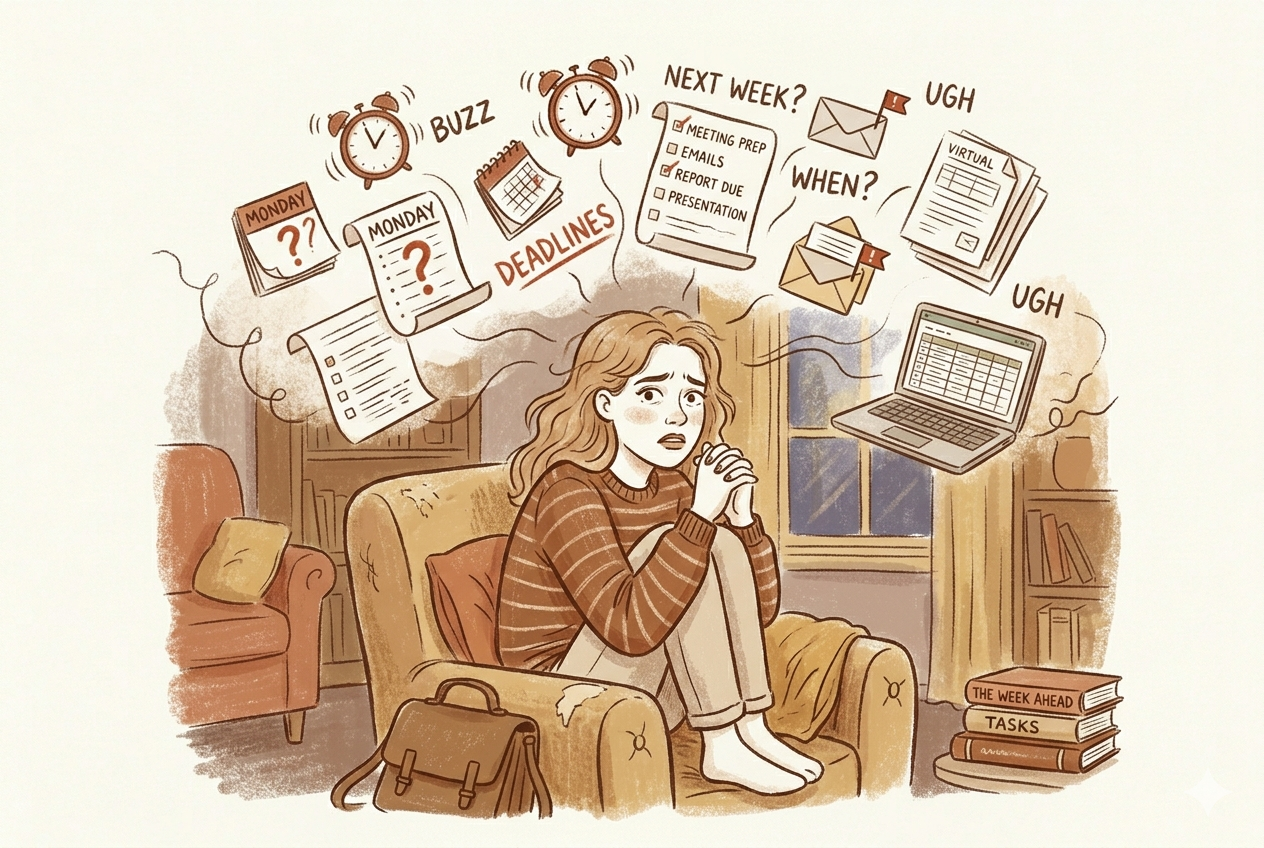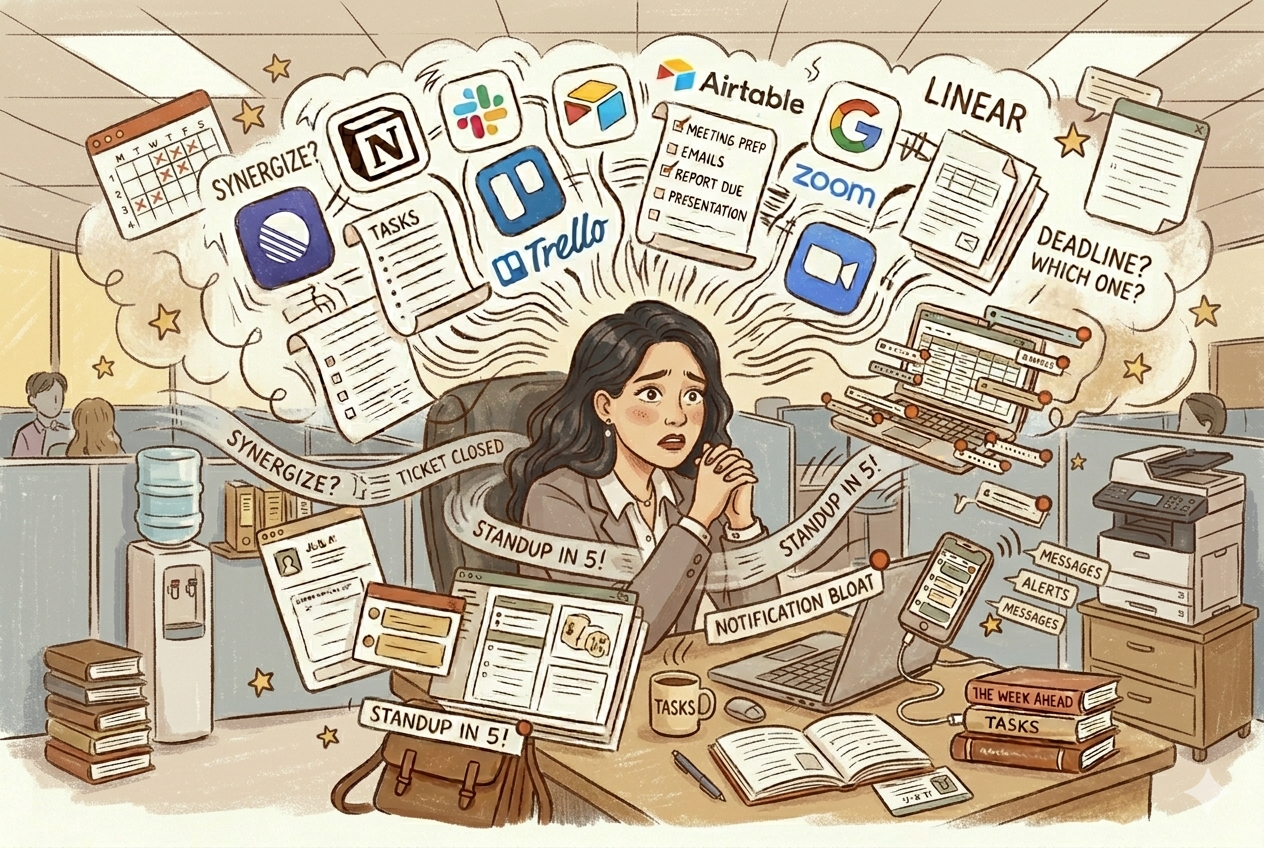
There's a particular kind of afternoon tiredness that knowledge workers know well. It's not the tiredness of having done a lot. It's the tiredness of having been interrupted constantly, switched between seventeen different things, attended three video calls you didn't need to be on, responded to an unknowable number of Slack messages, and arrived at 5pm with the vague sense that you were busy all day but couldn't tell you what you actually produced.
This is the texture of modern office work. And it has a name: cognitive overload. Not burnout exactly, not stress exactly. Though both of those follow. Something more specific. The feeling of a brain that has been asked to hold too much, switch too fast, and never fully finish anything.
The tools that were supposed to fix this, to make us more connected, more efficient, more organised, are, according to a growing body of research, making it substantially worse. And the story of how that happened is more interesting, and more uncomfortable, than the productivity industry wants to admit.
We have more productivity tools than ever. Focus is at a three-year low.
Start with the numbers, because they're striking. The average focused work session in 2025 lasted just 13 minutes and 7 seconds, down 9% from 2023, according to ActivTrak's State of the Workplace Report. 79% of US workers get distracted within one hour of starting a task. 59% cannot maintain focus for even 30 minutes without interruption.
Microsoft's 2025 Work Trend Index found workers receive a notification from meetings, emails, or chat tools every two minutes. Over a full working day, that adds up to 275 separate interruptions. Research from the University of California, Irvine, established that it takes an average of 23 minutes and 15 seconds to fully regain deep focus after a single disruption. The arithmetic here is devastating: with interruptions arriving every two minutes and each requiring 23 minutes of recovery, the modern worker can never complete a single recovery cycle before the next interruption arrives. Full focus becomes, mathematically, impossible.
This is not a discipline problem. It is a systems problem. And the systems, largely, are the tools.
The Slack problem nobody talks about out loud
Slack and Microsoft Teams were built to replace email, to make communication faster, more transparent, more human. In many ways they succeeded. In one significant way, they made things worse.
Email had an implicit social contract: responses were expected within hours, sometimes days. Slack collapsed that contract entirely. The interface, the green dot, the unread count, the typing indicator, creates a psychological environment of constant availability. Approximately 56% of workers report feeling obligated to respond immediately to notifications, which researchers describe as a "reactive operating mode": your workday is defined not by what you chose to work on, but by what came in most recently.
Your workday is defined not by what you chose to work on, but by what came in most recently. That is not productivity. That is triage dressed up as collaboration.
That is not productivity. That is triage dressed up as collaboration. And the cognitive cost compounds: according to a joint study by Qatalog and Cornell, it takes about 9.5 minutes on average to get back into a productive workflow after toggling to a different digital app. Each Slack notification isn't just the seconds it takes to read and respond — it's the nearly ten minutes of recovery that follow. Multiply that across 275 daily interruptions and you begin to understand why the average knowledge worker loses close to four hours daily to interruptions and task-switching.
There's also the tool proliferation problem sitting beneath the messaging apps. Asana's research found that workers switch between apps and tools an average of 1,200 times per day, a number that keeps growing as the toolstack expands. Every switch carries a cognitive tax. Every new tool requires a new mental model, a new notification channel, a new place to check. The promise of integration rarely survives contact with the reality of seventeen browser tabs.
What video calls are actually doing to your brain
The science of video call fatigue is more specific, and more surprising, than most people realise.
It's not the screen time. We've been staring at screens for decades without the particular exhaustion that follows a day of back-to-back Zoom calls. The fatigue comes from the specific demands that video conferencing places on cognitive processing. Research by Jeremy Bailenson at Stanford's Virtual Human Interaction Lab identifies four distinct mechanisms: the unnaturally close eye contact of a grid of faces, the constant monitoring of your own image, the reduced movement caused by staying in frame, and the cognitive overhead of reading social cues through a compressed, pixelated medium.
In face-to-face conversation, your brain processes social signals largely automatically. On a video call, that processing becomes effortful. The cognitive load is higher because you're required to send exaggerated nonverbal cues, strong nodding, visible reactions, while simultaneously reading the same signals from multiple other participants. You are performing being present while also trying to actually be present. The two things compete.
A 2025 study in Scientific Reports found a simple intervention that helps: turning off the self-view feature during video calls can significantly reduce both cognitive load and fatigue. When participants couldn't see their own image, they reported less mirror anxiety and spent less mental energy monitoring their appearance. That's energy that could go toward the meeting's actual content. It's a small fix for a large problem, but the fact that hiding your own face measurably improves cognitive performance tells you something about how much processing that face was consuming.
The Zoom fatigue picture has evolved since the pandemic. A 2024 study found that the exhaustion observed in 2020–21 may have partly reflected the symbolic weight of video calls during lockdown. By 2024, video calls had become normalised and workers had developed unconscious strategies to manage their cognitive demands. The acute crisis has passed. But the chronic, low-level drain of a calendar full of video meetings remains. Now just accepted as the texture of work rather than named as a problem.
The AI productivity paradox
Here is where the story gets genuinely strange. Into this already-overloaded environment, the productivity industry has introduced artificial intelligence, promising once again to reduce cognitive load. And once again, the evidence suggests it is adding to it.
Harvard Business Review's February 2026 research confirmed what many knowledge workers already felt: AI tool adoption is correlated with increased work intensity, not decreased workload. A UC Berkeley longitudinal study found that 67% of workers who adopted AI tools in 2025 reported working more hours, not fewer, by the end of the year.
The mechanism is the same one that played out with email, with Slack, with every productivity tool before it: when a technology makes output faster, organisations raise their expectations. The time saved disappears into expanded scope. And AI adds its own cognitive overhead on top. Prompt engineering, output verification, hallucination checking, the constant background task of deciding when to trust the tool and when to question it. Workers spend less time creating from scratch but more time reviewing, correcting, and refining AI-generated outputs. That demands sustained attention and critical judgment. It's not less work. It's different work, and often harder.
When a technology makes output faster, organisations raise their expectations. The time saved disappears into expanded scope. This has happened with every productivity tool. AI is no different.
43% of office workers now spend more than 10 hours per week on what Deloitte's 2025 research calls "productivity theater", looking busy without producing real output. 41% of the workday goes to tasks employees say add no value. More tools. More coordination required. More reasons to check another screen. Less of what actually matters.
The deeper problem with productivity culture
There is a philosophical dimension to all of this that rarely appears in the productivity literature, because the productivity literature is, by definition, invested in selling you more productivity.
Our current model of productivity was designed for factories. Frederick Taylor's scientific management gave us the concept of measurable output. It was built around physical goods you could count. It mapped reasonably well onto industrial work. It maps very poorly onto knowledge work, where the most valuable output is often invisible, where deep thinking requires sustained uninterrupted time, and where the relationship between hours worked and value produced doesn't follow a straight line.
A longitudinal study from the University of Pennsylvania found that participants who internalised productivity as a moral value showed significantly higher rates of anxiety, depression, and burnout than those with more balanced views of work. The problem isn't just the tools. It's the belief system underneath them. The idea that the solution to cognitive overload is always more efficiency, more optimisation, more tools to manage the tools. It isn't. Sometimes the solution is less.
What actually helps
The research is fairly consistent on what genuinely reduces cognitive load in knowledge work, and it is stubbornly low-tech.
Notification batching, checking messages at fixed intervals rather than responding reactively, measurably reduces stress and improves focus quality. Protecting blocks of uninterrupted time for deep work, even just 90 minutes, produces disproportionate output gains. Running a meeting audit, asking which recurring meetings actually require your attendance, tends to reveal a significant portion that don't. Knowledge workers with at least 3.5 hours of daily focus time report being measurably more productive than those with less.
And then there's the other side of cognitive load. The things that accumulate in your head outside the tools. The follow-ups you haven't done. The things you meant to raise in the meeting and forgot. The parallel track of undone tasks running beneath your actual work. The tools handle the incoming. They do less for the residue.
Which is where Carry comes in
Carry was built for a specific problem: the cognitive cost of the things that don't live in your tools. Not the Slack message you're yet to reply to. That's in Slack. Not the calendar invite. That's in your calendar. But the thing you thought of mid-meeting and couldn't write down. The follow-up you need to make but haven't captured anywhere. The low-level hum of tasks and responsibilities that exist only in your head, draining working memory quietly and continuously.
The research that shaped Carry is the same research in this article. Context switching costs you 23 minutes per interruption. Unresolved open loops compete for cognitive resources until they're externalised. The brain doesn't distinguish between a work task and a personal one when calculating cognitive load. It's all the same finite resource. Getting things out of your head and into something you trust isn't a productivity hack. It's cognitive relief. And it compounds: every item that stops living in your working memory is capacity returned for the work that actually requires your full attention.
The tools aren't going away. The meetings aren't going away. But the gap between what your tools capture and what your brain is holding, that part is solvable. And it turns out the solution is simpler than another app. It's just: get it out of your head.