In June 2026, a clip from Steven Bartlett's Diary of a CEO podcast went viral for reasons its host probably did not intend. Bartlett, entrepreneur and one of the UK's most prominent voices in the productivity and self-optimisation space, recounted having his first drink in a year: a few glasses of wine at a social occasion. The consequence, he explained, was catastrophic. Worse sleep. Poorer diet the next day. A bad podcast. A missed gym session. Three days of measurable decline, all tracked on his Whoop wearable. "It ruined three days of my life," he said.
The response was immediate, loud, and, depending on your perspective, either long overdue or slightly hysterical. Radio presenter Greg James launched what he called an anti-Bartlett cult and urged his audience to join the anti-optimisation movement. TV presenter Vogue Williams revealed that her own Whoop had been giving her anxiety for months; low recovery scores first thing in the morning were setting the emotional tone for her entire day. She eventually stopped wearing it. Fearne Cotton said she sometimes podcasts better on a hangover. The reaction was not really about wine. It was about something that had been building for a long time.
Optimisation culture had finally met its limits. And a lot of people, millennial women in particular, had been waiting for someone to say so out loud.
How we got here
The productivity movement did not arrive all at once. It crept in gradually, wearing different outfits in different eras. The Fitbit in 2009. The quantified self movement that followed, which encouraged people to track sleep, steps, calories, mood, heart rate variability, and anything else that could be assigned a number. The rise of the morning routine as a genre of content. The hustle culture of the mid-2010s, which reframed overwork as a personality trait and rest as something you earned rather than something you needed.
Then came TikTok, which did not create any of these pressures but scaled them to an audience of hundreds of millions and aestheticised them into something aspirational. The #ThatGirl hashtag, which emerged in 2021 and accumulated 17.4 billion views by August 2024, is the purest expression of where all these threads converged.
#ThatGirl on TikTok — 5am workouts, green smoothies, journaling, deep work sessions and structured morning routines, presented as the template for an optimised life.
The That Girl is up at 5am. She works out before most people are awake. She journals. She eats whole foods, aesthetically arranged. She has a skincare routine and a side hustle and a structured deep-work block and a gratitude practice. She is productive and healthy and calm and beautiful, all before 9am, all documented on her phone, all presented not as effort but as aspiration. Research published in Social Sciences in August 2025 found that the That Girl archetype functions as an upward comparison target for young women, with measurable detrimental effects on affect, body satisfaction, and self-discipline.
The researchers noted something important: unlike previous social media ideals that focused primarily on appearance, the That Girl trend optimises almost every area of life simultaneously. It is not enough to be thin. You also need to be productive. And calm. And organised. And disciplined. And health-conscious. And ambitious. The scope of the project is total.
Unlike previous social media ideals that focused primarily on appearance, the That Girl trend optimises almost every area of life simultaneously. The scope of the project is total.
The technology that made it measurable
What makes the current era of productivity culture different from previous versions is the hardware. The Apple Watch. The Whoop. The Oura Ring. The Fitbit. Strava and its weekly mileage summaries and segment comparisons and the quietly devastating experience of being overtaken on a route you thought was yours. MyFitnessPal and its calorie deficits. Sleep trackers that assign you a score before you have had coffee and let you know, in precise numerical terms, how inadequately you rested.
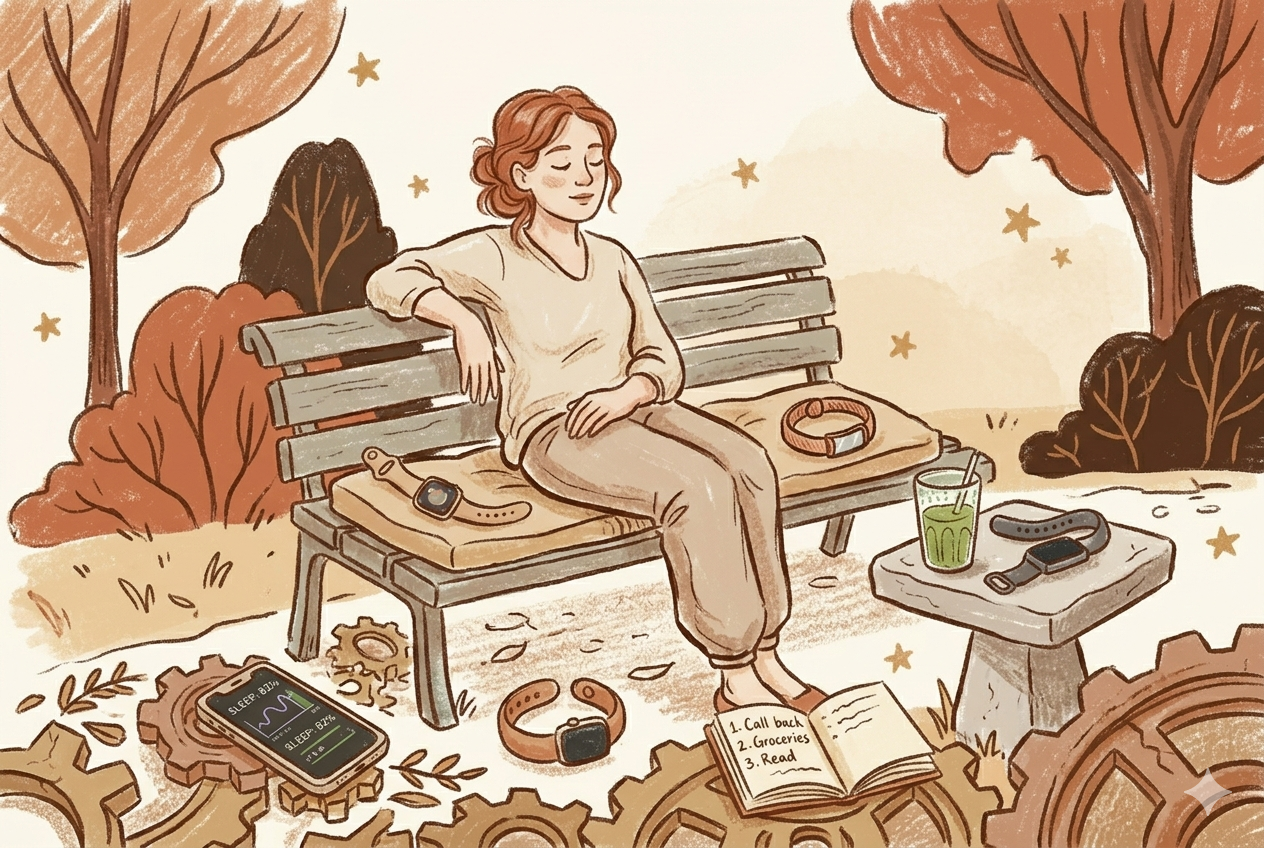
These tools were marketed as empowering. And for some people, some of the time, they are. But they introduced something new into the relationship between people and their own bodies: the ability to be continuously assessed. Not just to feel tired, but to have a recovery score that confirms you are performing below optimal. Not just to have had a good run, but to compare that run to every other run, every other runner, and the ghost of your own past performance.
The Bartlett story captures this precisely. He did not just feel a bit rough after a few glasses of wine. He had data. His Whoop told him, in granular detail, how each downstream effect had cascaded through his system. The tracker did not just record the impact of the wine; it mediated his entire experience of it, transforming what might have been a mildly off day into a documented, quantified failure with a three-day damage report.
Vogue Williams' experience with her Whoop is, in this light, not an outlier but a pattern. Research on wearable technology and anxiety has found that for a meaningful proportion of users, tracking data does not reduce health anxiety. It feeds it. The low recovery score becomes the first thing you see in the morning, and it colours everything that follows. The metric that was supposed to help you perform better becomes the thing making you feel worse.
Who is bearing the weight of this
The burnout data is uncomfortable reading. Women are burning out at substantially higher rates than men: 59% of female employees reported burnout in 2024, compared to 46% of men. Research from CERP found that women are three times more likely than men to experience clinical burnout, and that by age 40, one in seven women has burned out. Millennial women sit at the intersection of multiple pressures: the domestic mental load that research consistently shows falls disproportionately on them, the professional expectations of a generation that was told it could have everything, and the cultural pressure of a social media landscape that turned self-improvement into a public performance.
The peak burnout age, according to a March 2025 Talker Research poll, is now 25. Seventeen years earlier than the historical average of 42. A generation is entering the workforce already running close to empty, and then spending the next decade and a half being told that the answer is better habits, an earlier alarm, a more structured morning, a cleaner diet, a smarter tracker.
The millennial experience specifically is worth sitting with. This is the generation that graduated into a financial crisis, worked through a housing market that made ownership feel impossible, had children in an era of increasingly expensive childcare and decreasing social support, and came of age on social media just as the comparison machine was reaching its most sophisticated form. The productivity culture that flourished in this context did not emerge despite all of that pressure. It emerged because of it. When external circumstances feel uncontrollable, optimising what you can control — your morning, your body, your habits, your metrics — becomes a coping mechanism. The problem is that it is an exhausting one.
The backlash that is already happening
What the Bartlett moment revealed is that the backlash was already well underway before anyone named it. The response was not manufactured outrage. It was recognition: a collective exhale from people who had been quietly finding the whole thing a bit much for some time.
"Optimisation is killing fun," Greg James said in his Instagram reel. He was not making a sophisticated philosophical argument. He was saying something simpler and more resonant: that a life lived primarily in service of metrics is not a life that feels like living. That the quantified self, taken to its logical conclusion, produces a version of existence in which a glass of wine with friends is a recovery score risk rather than a pleasure.
Greg James's anti-optimisation Instagram reel — "Optimisation is killing fun."
The Gen Z response has been characteristically direct. A TikTok trend that emerged in 2025, set to Charli XCX's "I Think About It All the Time," saw users, particularly women, listing "propaganda I'm not falling for" including hustle culture, 5am wake-ups, and the idea that rest has to be earned. The That Girl trend has its own counter-movement now, with creators explicitly rejecting the premise that every hour of every day should be accounted for and improved upon.
There is also something generationally interesting happening. The wellness and productivity influencer space, which was dominated by millennial voices for years, is being reappraised by the same generation that built it. Women who spent their late twenties and early thirties tracking macros and optimising sleep and building morning routines are now, in their late thirties and forties, asking what exactly it was all for. The answer, for many of them, is not a satisfying one.
The right relationship with your mental load
None of this is an argument against self-improvement, or against tools that help you feel better, or against understanding your own patterns. It is an argument against a particular framing of all of those things: the one that treats human life as a performance to be optimised, rest as a failure of discipline, and any metric that comes in below target as a problem to be fixed.
The most useful reframe might be this: the goal is not to do more. The goal is to feel less overwhelmed. Those are not the same thing, and a great deal of productivity culture conflates them in ways that are genuinely harmful.
The goal is not to do more. The goal is to feel less overwhelmed. Those are not the same thing, and a great deal of productivity culture conflates them in ways that are genuinely harmful.
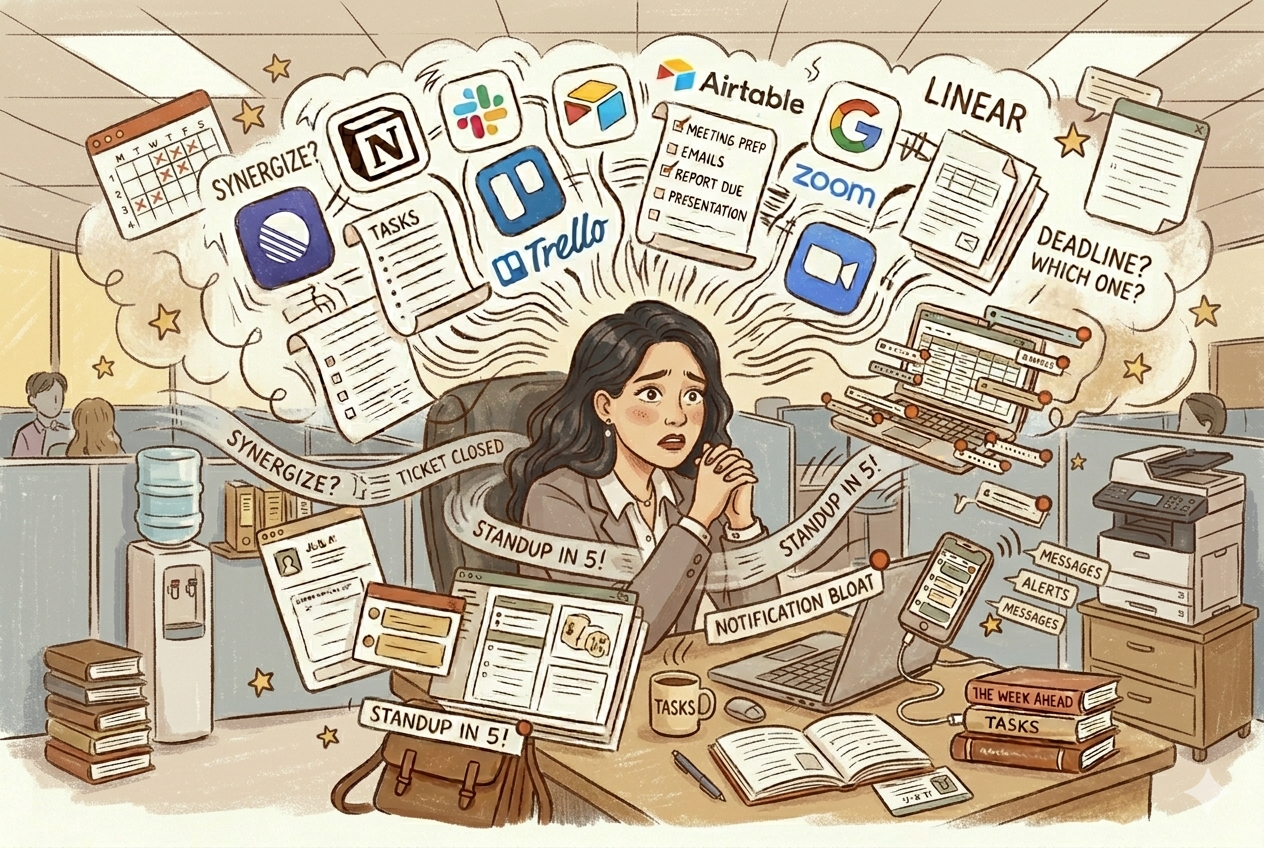
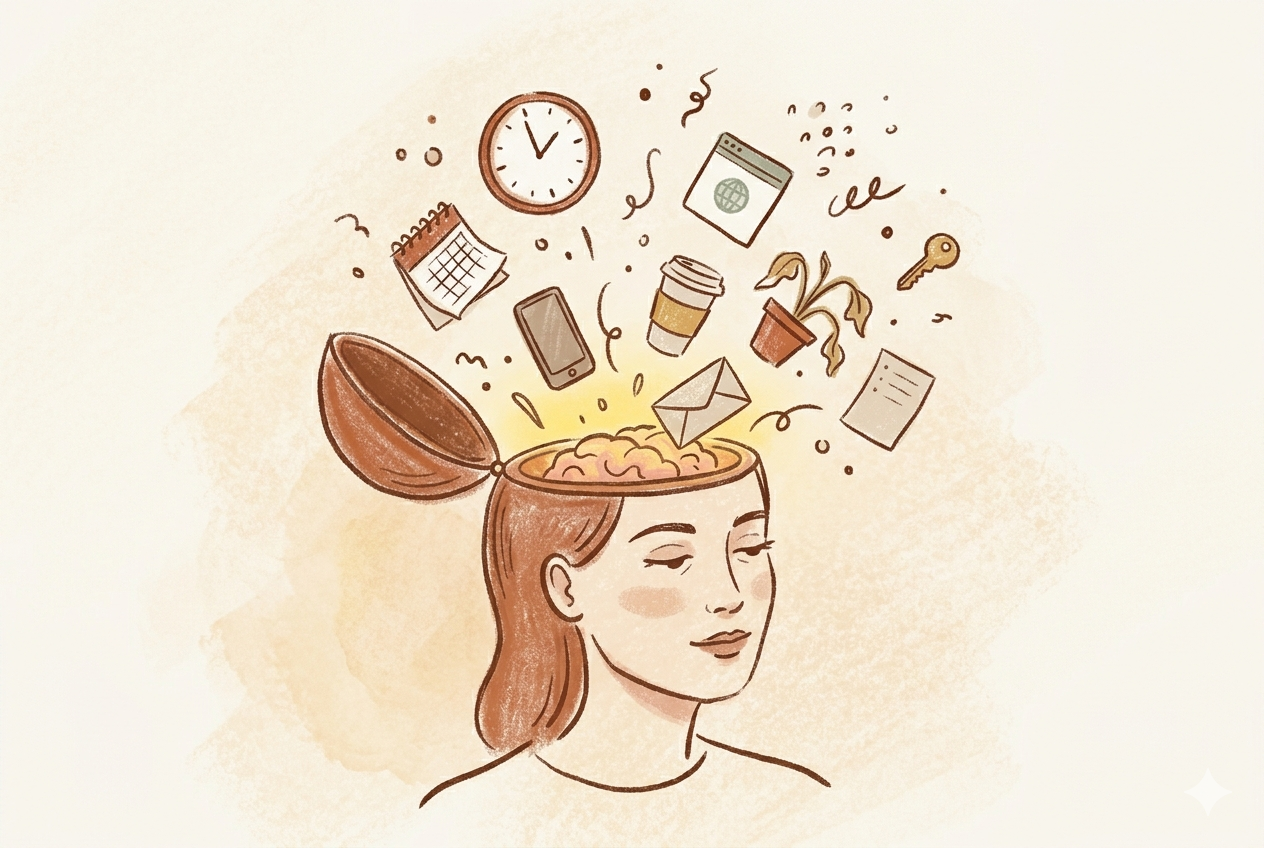
Feeling less overwhelmed does not require a better morning routine or a higher recovery score. It requires, in the most practical and unglamorous sense, reducing the cognitive cost of managing your life. Getting the things out of your head that do not need to be there. Creating a little more space between the incoming demands and your capacity to respond to them. Not optimising your life. Just making it slightly less exhausting to carry.
Carry was built as the antidote
Carry is not a productivity app. We want to be explicit about that, in a landscape where everything from sleep tracking to journaling to meal planning has been absorbed into the productivity industry and repackaged as self-improvement. Carry is not asking you to do more, track more, optimise more, or become a better version of yourself by 7am.
It was built as a direct response to the pressure this article describes. Not a tool that adds to the load, but one that reduces it. The idea is simple and deliberately unambitious: the things in your head that do not need to be there are costing you something. Not because you are failing to optimise them — because holding them is itself a form of effort, and effort has a limit.
Getting them out — by speaking, quickly, with as little friction as possible — does not make you more productive. It makes you less burdened. There is no metric for that. No recovery score. No weekly summary showing you whether you externalised your thoughts more efficiently than last Tuesday. Just the quiet that comes when the list in your head is somewhere else for a moment.
The Bartlett moment, and the wave of recognition that followed it, suggests that a lot of people are ready for a different conversation about what it means to manage a life. Not how to squeeze more out of it. Not which habits to stack or when to set the alarm. Just: how do I make this feel a little less like so much? How do I put some of this down?
That is not a productivity question. It is a relief question. Carry is built for that question. And relief, it turns out, is what most people actually needed all along.