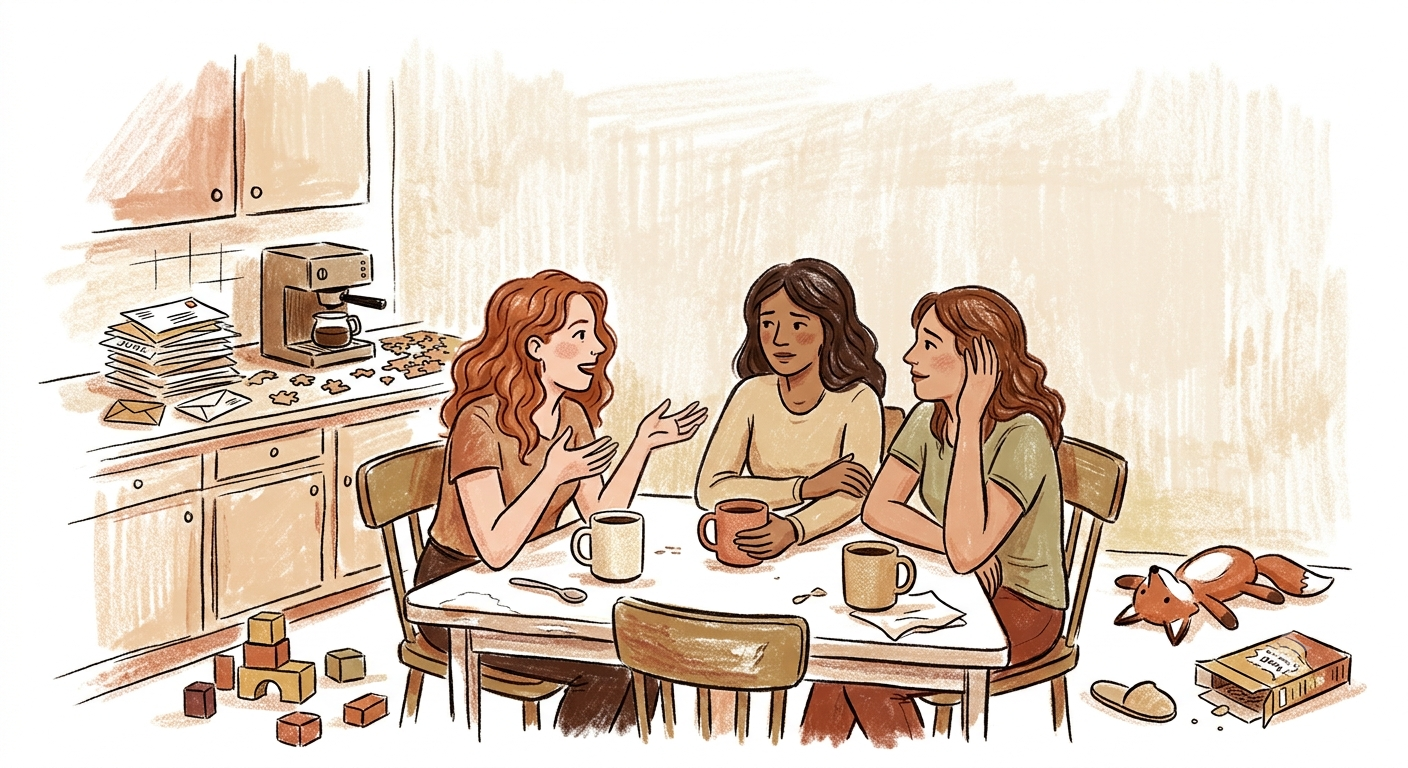
You know the feeling. Something has been sitting on you all day. A frustrating thing at work, a conversation that didn't go right, a list of tasks that's been quietly pressing on you since Tuesday. And then you call a friend, or sit down with someone you trust, and you just say it. All of it. In no particular order, probably with some repetition, possibly not making complete sense. And by the end of it, something has shifted. The thing feels smaller. You feel lighter. You can breathe a bit more easily.
Most people assume this is just what friendship is for. The listening, the commiserating, the "I know, that's awful." And those things matter. But there is also something happening neurologically when you vent that has nothing to do with being validated or feeling understood. The act of putting words to something, of saying it out loud, does something specific to your brain. And the research is surprisingly clear about what.
Name it to tame it
In 2007, psychologist Matthew Lieberman at UCLA ran a study that sounds simple but turned out to be quite significant. He showed people emotionally charged images while scanning their brains. Some participants were asked to label what they were feeling. Others weren't. When people named their emotion, even just attaching a single word to it, something measurable happened: the amygdala, the part of the brain that processes threat and generates emotional distress, became less active. And the prefrontal cortex, the part involved in rational thinking and regulation, became more active.
Lieberman described it as hitting the brakes. "In the same way you hit the brake when you're driving when you see a yellow light, when you put feelings into words, you seem to be hitting the brakes on your emotional responses." The phrase he later coined for this became one of those neuroscience shorthand terms that actually earns its popularity: name it to tame it.
"When you put feelings into words, you seem to be hitting the brakes on your emotional responses." — Matthew Lieberman, UCLA
The implication is straightforward but easy to underestimate. The relief you feel after a good vent is not just psychological. It is not just the comfort of being heard. Something structural has happened in your brain. The part of you that was generating the distress has literally quietened down. You feel calmer because you are calmer, in a measurable, neurological sense.

This is why "I just need to talk about it" is not self-indulgence. It is a completely rational strategy for managing an overloaded nervous system.
Why your friend specifically helps
There is another layer to this, which is about why talking to another person specifically seems to work so well. Not just saying things out loud to yourself. Not just writing them down. But actually being in the presence of someone who is calm, listening, and with you.
Stephen Porges, a neuroscientist at Indiana University, spent decades developing what he called Polyvagal Theory. The core idea is that the human nervous system is not just wired for individual survival. It is wired for social connection as a biological resource. When we feel safe with another person, when we can hear a calm voice and see a relaxed face, our own nervous system responds. It picks up the signals and begins to mirror them. Heart rate slows. The fight-or-flight response dials back. The part of the nervous system that supports rest and connection takes over.
Porges called this co-regulation. And it is not a metaphor. It is a literal physiological process. Two nervous systems in contact, with one helping the other settle. This is why a hug from the right person can feel like something physically unlocking. Why a conversation with a calm, trusted friend can shift your whole state in a way that sitting alone with your thoughts often can't.
Think about that friend who always makes you feel more grounded after you talk to them. The one whose voice somehow levels you out. That is not just personality. That is your nervous systems doing something together that neither of you could do quite as well alone.
But here is the part people get wrong about venting
The research on venting is not entirely straightforward, and it is worth being honest about the nuance. Because there is a version of venting that does not help. And some research suggests it can actually make things worse.
A meta-analysis published in 2024, looking at 154 studies on anger, found that venting anger specifically — ranting, replaying, getting more and more wound up — does not reliably reduce that anger. In some cases it increases it. Brad Bushman at Ohio State, who has studied this for decades, puts it plainly: venting anger is like adding fuel to a fire. The catharsis theory, the idea that expressing negative emotion discharges it, turns out to be largely wrong when it comes to anger.
So why does venting sometimes feel so helpful and other times leave you more agitated than you started?
The distinction seems to be in what you are doing when you vent. If you are naming, articulating, and processing — putting the experience into words and moving toward some kind of understanding of it — that is the kind of venting that helps. If you are ruminating, replaying, and re-inflaming — going around the same loop and getting more activated each time — that tends to maintain or worsen the distress. The same conversation with the same friend can be one or the other depending on where it goes.
Venting works when you are naming and processing. It gets complicated when you are replaying and re-inflaming. The words are the same. What you're doing with them is different.
Dr. Judith Joseph, writing in her 2025 book High Functioning, describes healthy venting as "constructive emotional release" and makes the point that reciprocity matters. You need to feel genuinely heard, not just tolerated. And the venting should eventually move toward something: understanding, perspective, or simply the relief of having said it and been witnessed. Emotional dumping without any of that can leave both people feeling worse.
The brain dump, when there is no one to call
Not every difficult moment comes with a friend available on the other end of the phone. And not everything you need to get out of your head is emotional in the way a rant is emotional. A lot of it is just the load. The list. The things sitting on you that haven't been named yet, not because they're traumatic but because they haven't been put anywhere.
The brain dump is essentially the solo version of the vent. And it works through the same mechanism: taking what is diffuse and internal and making it specific and external. Giving it words. Getting it out of the swirling, pressurised state it exists in inside your head and into a form that has edges.
James Pennebaker's research on expressive writing, which we have covered in these pages before, found that the act of putting difficult experiences into words, even just for 15 minutes, produced measurable effects on both emotional and physical health. People who wrote about what was on their minds visited the doctor at roughly half the rate of those who didn't. The relief wasn't about being heard. It was about the articulation itself.
The same principle applies to the logistical mental load that most of us carry. The things that need doing. The things you keep nearly forgetting. The half-formed plans and unresolved tasks that sit in working memory competing for space with everything else you're trying to think about. They don't need to be processed emotionally. They just need to be externalised. Given a form outside your head so your brain can stop holding them.
Why voice specifically works so well
You can write things down and get the same benefit. But there is something about speaking that adds another dimension, particularly for the emotional weight of it.
Speaking is faster than writing. It's closer to the speed of thought. And it activates the vocal apparatus, the breath, the physical act of forming sound, which is itself regulated by the vagus nerve, the same nerve involved in the co-regulation process Porges described. Talking out loud is not just cognitively different from thinking silently. It is physiologically different. Your body is involved in a way it isn't when you type.
This is partly why talking to yourself, which most people do more than they admit, can be genuinely useful. Researchers who study self-talk have found that verbalising thoughts out loud, even privately, changes how you process them. It creates a kind of external witness, even when the witness is yourself. You hear it differently when you say it than when you think it. The externalisation does something the internal version doesn't.
You hear it differently when you say it than when you think it. The externalisation does something the internal version doesn't.
Which is what Carry is built around
The relief that comes from a good vent with a trusted friend comes from several things at once: the articulation, the co-regulation, the feeling of being witnessed. Carry can't replicate all of that. Human connection is human connection, and no app should pretend otherwise.
But a meaningful part of what makes venting work — the act of putting things into words, of saying them out loud, of externalising what was internal — is available any time. Not just when someone is free to listen. Not just at a reasonable hour. Any time the pressure builds and you need to get something out.
You tap. You speak. You say what's there, in whatever order it comes out. Carry listens, organises, and holds it. And your brain, having done the thing it needed to do, gets to let it go.
It is not a substitute for the friend. But it is available at 11pm on a Tuesday when the list won't stop. And sometimes that is exactly what is needed.